

VISUAL IDENTITY OF THE OLD CITY OF MOSTAR
Traditional Crafts as a Mirror of Authenticity
„Crafts are one of the main hallmarks of cities. As symbols of their roots, history and identity, they identify and shape the distinctive character of different cultures. The Arts and Crafts of the World Heritage Cities represent a unique cultural legacy. Their survival and transmission to future generations contribute to safeguarding the values of authenticity and integrity for which these cities were declared World Heritage.“
– OWHC (Organization of World Heritage Cities), project Arts and Crafts in World Heritage Cities (https://ciudadespatrimonio.eu)
When people speak of the “visual identity” of Mostar, many first think of the Old Bridge, the stone alleys, and the shimmering Neretva River. However, the visual identity of the Old Town is also reflected in the life that unfolds there – in the faces of merchants and artisans, the aroma of Bosnian coffee, the call to prayer echoing from minarets, the sound of church bells, the rhythm of hammers striking copper, and the smile of a craftsman passing his knowledge to new generations.
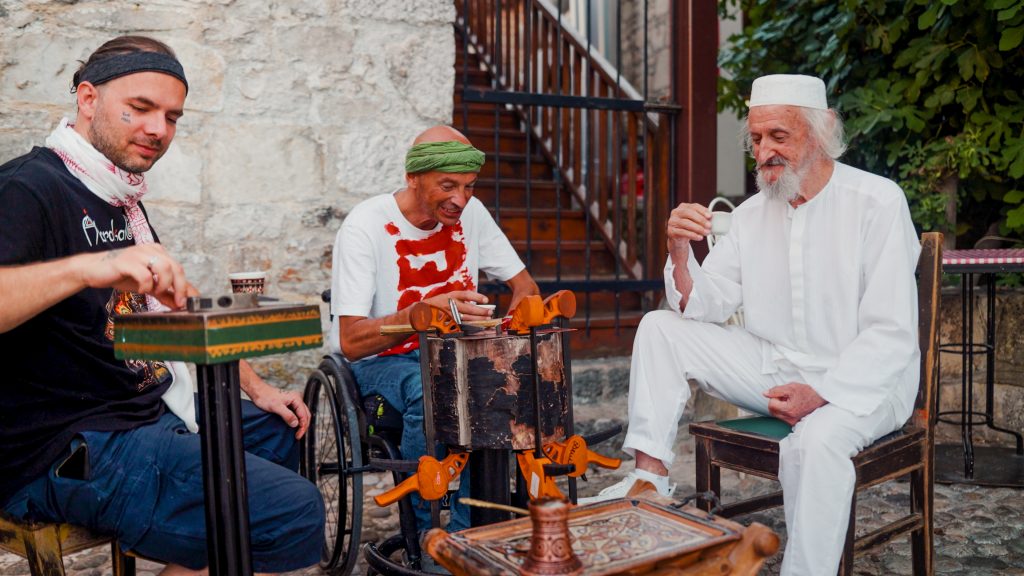
Such a moment is captured in the video featuring master Safet Begović (84), a teacher of the coppersmithing craft, who regularly visits us to see how his students are doing today. The video was filmed at a stand that has been located there since 2017 – as a symbol of the living continuity of the traditional craft in Mostar.
Today, however, the City Administration of Mostar intends to remove this stand under the absurd pretext that it “disturbs the visual identity of the Old Town.” This decision was made despite the positive opinion of the Old Town Agency, the institution officially responsible for protecting the visual identity and integrity of the heritage zone.
It is important to understand that, in the context of UNESCO guidelines, the term visual identity does not refer exclusively to the physical appearance of space, but to the overall experience of authenticity – the harmony between visual, auditory, and ambient elements that together create the “spirit and feeling of place.”
In other words, visual identity does not describe only facades, but what animates them – the rhythm of life, sounds, gestures, materials, scents, and activities that make us recognize and experience a place as authentic.
When someone thinks of the Old Town of Mostar, its visual identity is the feeling that arises in their mind – not only the stone and arch of the Old Bridge, but also the sound of coppersmiths’ hammers, the gleam of copper in shop windows, handmade souvenirs created in traditional ways, and the presence and mann
ers of the native inhabitants. If all of this were removed, the bridge and cobblestones would physically remain – but the visual identity would disappear, because it would lose the life and spirit that make it alive and recognizable.
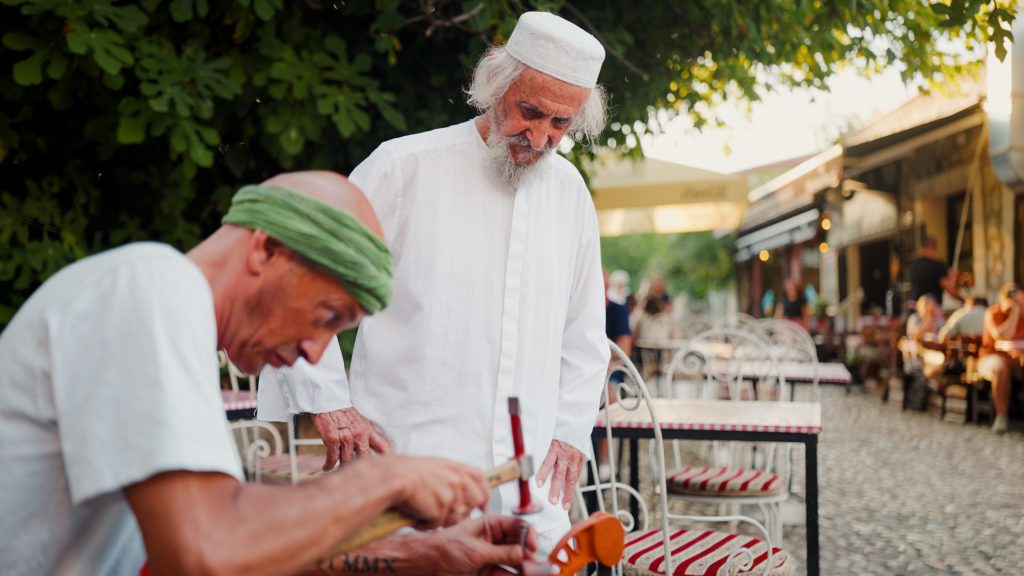
Therefore, this very scene – the teacher, the students, the copper, and the hammer – represents the true, living, and rarely preserved visual identity of the Old Town.
It is a testament to the centuries-old continuity of Bosnia and Herzegovina’s intangible cultural heritage – the part that breathes, that has scent, sound, and the soul of Mostar.
🎥 The video with Master Safet Begović captures that spirit of the Old Town in its most authentic form – we invite you to watch it and feel for yourself what the true visual identity of Mostar means.

Leave a Reply